Strength Over Sensitivity: The Japanese Art of Teaching Skin to Adapt Rather Than Avoid

There is a particular kind of frustration that comes from reactive skin. You eliminate fragrance. You switch to mineral sunscreen. You pare your routine down to four products, then three, then two—and still, a flush of irritation appears without warning, as if the skin itself has grown more suspicious with every accommodation you make on its behalf. If this cycle feels familiar, you are not alone. And according to Japanese skincare philosophy, you may have been approaching the problem from entirely the wrong direction.
In Japan, the relationship between a woman and her skin is understood not as one of management, but of cultivation. The goal is not to construct an obstacle course of hypoallergenic products that shields skin from every conceivable irritant. The goal is to raise skin that is fundamentally resilient—skin that has been patiently, methodically strengthened from within until it no longer requires constant protection from without.
This distinction is subtle but profound. And for a growing number of American women who have spent years chasing sensitivity solutions, it is proving to be the answer they never thought to look for.
The Western Diagnosis Problem
American skincare culture excels at identification. There are patch tests, elimination diets for the face, dermatologist-approved lists of known irritants, and entire product lines engineered around the premise that sensitive skin must be insulated from the world. This approach is not without merit—for acute conditions, clinical intervention matters. But as a long-term philosophy, it carries an unintended consequence.
When skin is perpetually shielded from challenge, it loses the opportunity to build tolerance. Much like a body that never encounters mild physical stress fails to develop muscular endurance, skin that is continuously buffered from all potential irritants may gradually lose its capacity to regulate itself. Sensitivity, in this model, does not diminish. It deepens.
Japanese aestheticians have long observed this pattern. The practice of endlessly reformulating one's routine in response to every new reaction is seen not as diligence, but as a kind of interruption—a disruption of the skin's own adaptive intelligence.
The Barrier as Foundation, Not Fortress
At the center of Japanese resilience philosophy is the skin barrier, known in Japanese wellness culture as the skin's mamori—its natural protection. Western skincare acknowledges the barrier as well, of course, but tends to treat it as something that must be defended against external assault. Japanese philosophy treats it as something that must be nurtured into strength.
The difference plays out in practice. Where a Western approach might reach for a ceramide-dense occlusive balm the moment tightness appears, a Japanese approach asks a prior question: why is the barrier signaling distress in the first place, and what consistent conditions would allow it to repair itself over time?
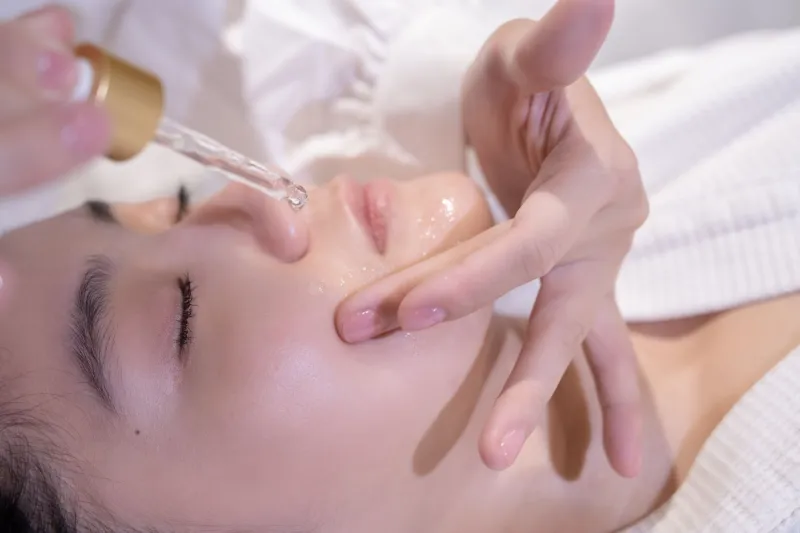
The answer almost always returns to simplicity, gentleness, and patience. Lightweight layering of hydrating essences—a practice deeply embedded in Japanese skincare tradition—is designed not to overwhelm the skin with ingredients, but to teach it to receive moisture gradually and retain it without assistance. Over weeks and months, the barrier learns. It becomes less porous, less reactive, more capable of self-regulation.
This is not a quick transformation. But in Japan, that is considered entirely beside the point.
Consistency as a Form of Courage
One of the most counterintuitive aspects of the Japanese approach to reactive skin is its relationship with consistency. In the West, a product that causes even a mild reaction is typically discontinued immediately. In Japanese practice, a mild response is often considered information rather than instruction—something to observe carefully, not necessarily to act upon by abandoning the product entirely.
This is not recklessness. It is discernment. Japanese skincare philosophy distinguishes between a reaction that signals genuine incompatibility and a reaction that signals the skin is simply unaccustomed to something new. The skin, like any system asked to adapt, may initially resist before it integrates. Giving it the time to do so—while monitoring carefully and adjusting gently—is considered an act of trust, not negligence.
American women who have adopted this mindset often describe a turning point: a moment when they stopped abandoning products at the first sign of unfamiliarity and began, instead, giving their skin the space to adjust. Many report that the very sensitivities they had been managing for years began to quietly diminish—not because they found the perfect formulation, but because they stopped reinforcing the pattern of reactivity with constant change.
The Nervous System Connection
Japanese wellness philosophy has always understood the skin as inseparable from the body's broader state of regulation. Chronic stress, irregular sleep, and a nervous system held in persistent tension are recognized as foundational contributors to reactive skin—not peripheral factors, but central ones.
This is why Japanese beauty rituals tend to be slow, sensory, and intentional. The act of pressing a warm cotton pad gently against the face, of applying an essence with deliberate, upward strokes, of taking sixty seconds in the morning to simply be present with one's reflection—these are not indulgences. They are calibrations. They signal to the nervous system that the body is safe, and that signal travels directly to the skin.
For American women accustomed to skincare as a task to complete between obligations, this may require a genuine shift in rhythm. But the results—skin that is measurably calmer, more even in tone, and less prone to the sudden flare-ups that once seemed random—tend to make the adjustment feel less like sacrifice and more like revelation.
Adapting the Philosophy for an American Routine
Adopting a resilience-first approach does not require dismantling everything you currently use. It requires a reorientation of purpose.
Begin by reducing the number of active ingredients in your routine. Exfoliating acids, retinoids, and brightening agents all place a burden of adaptation on the skin. If your skin is reactive, it may not yet have the baseline strength to process these demands. Simplify first. Allow the barrier to stabilize before reintroducing complexity.
Prioritize hydration above all else. A well-hydrated barrier is a more resilient barrier. Layering a lightweight hydrating toner before your moisturizer—applied with gentle, pressing motions rather than rubbing—mirrors the Japanese toner layering method and offers the skin a consistent, low-stress way to build moisture retention over time.
Finally, slow down the ritual itself. Even five minutes of quiet, intentional application each morning shifts the experience from routine maintenance to genuine care—and that shift, accumulated over time, changes not only how the skin responds but how you understand your relationship with it.
The Deeper Invitation
Japanese beauty philosophy does not promise that sensitive skin will disappear overnight. What it offers instead is something more enduring: a framework in which the skin is no longer understood as a liability to manage, but as a living system capable of growth, adaptation, and eventual quiet strength.
The women who have embraced this approach—both in Japan and increasingly across the United States—often speak of it in terms that go beyond skincare. They describe a kind of confidence that comes from knowing their skin can handle the day, not because every variable has been controlled, but because the skin itself has been trusted enough to become capable.
That is the Japanese secret. Not a formula. Not an ingredient. A philosophy of patience, and the willingness to believe that strength, given time, is always possible.