Fewer Steps, Flawless Skin: The Japanese Minimalist Beauty Secret American Women Are Finally Discovering
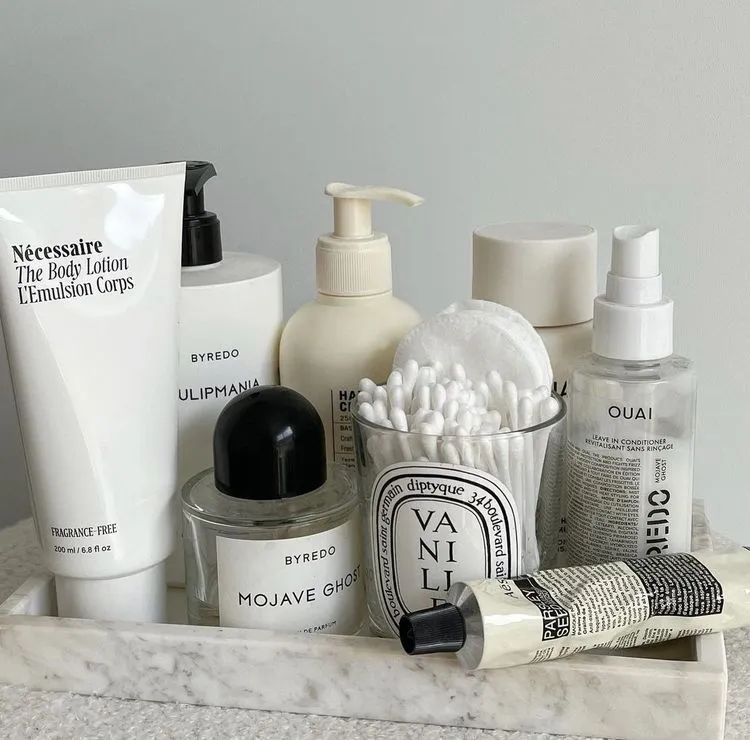
Photo: minimalist Japanese skincare products elegant vanity tray, via i.pinimg.com
Walk through the skincare aisle of any American beauty retailer and you will encounter an overwhelming landscape of serums, essences, toners, ampoules, masks, mists, and moisturizers—each promising to be the missing piece of your complexion puzzle. The cultural expectation, reinforced by social media and beauty influencers, is that more products equal better skin. Yet in Japan, where women are widely admired for their luminous, age-defying complexions, the prevailing philosophy runs in precisely the opposite direction.
Japanese beauty is not built on accumulation. It is built on discernment.
The Myth of the 10-Step Routine
The so-called 10-step Korean skincare routine captured Western imagination several years ago, and its influence has been significant. It introduced American consumers to layering, hydration-focused formulas, and the concept of skin as something to be tended with patience. However, in the cultural conversation that followed, Japanese beauty—a tradition both older and philosophically distinct—was frequently conflated with this maximalist approach.
The confusion is understandable, but the distinction matters enormously.
Japanese skincare philosophy is rooted in the concept of mottainai, a term that expresses reverence for resources and a deep resistance to waste. Applied to beauty, it translates into a purposeful curation of products rather than an endless accumulation of them. A Japanese woman's vanity is not sparse because she cannot afford more; it is sparse because she has chosen, with great care, exactly what her skin requires.
Quality as the Foundational Principle
When fewer products are used, each one bears greater responsibility. This reality drives Japanese formulators and consumers alike toward an uncompromising standard of ingredient quality. Japanese skincare has long prioritized bioactive botanicals—fermented rice water, camellia oil, sake extract, and pearl powder among them—precisely because these ingredients deliver measurable, visible results without the need for supplementary products to compensate for their shortcomings.
Fermented ingredients, in particular, represent a cornerstone of Japanese beauty science. The fermentation process breaks down molecules into smaller, more bioavailable forms, allowing active compounds to penetrate the skin barrier more efficiently than their unfermented counterparts. A single well-formulated essence containing fermented ingredients can accomplish what a three-product layering sequence achieves in a typical Western routine.
For American women accustomed to measuring value by volume, this can require a meaningful shift in perspective. The question is no longer How many products am I using? but rather How well does each product I use actually perform?
The Ritual of Intentional Application
Minimalism in Japanese skincare extends beyond product selection. It encompasses the manner in which those products are applied—a dimension that Western beauty culture rarely addresses with equivalent seriousness.
In Japan, the act of applying skincare is understood as a form of self-care in the truest sense: a daily ritual deserving of presence and attention. Products are not hastily patted on between tasks. They are warmed between the palms, pressed gently into the skin using deliberate upward motions, and given adequate time to absorb before the next step—if there is a next step at all.
This attentiveness is not merely ceremonial. The mechanics of application have a direct bearing on efficacy. Gentle pressing motions stimulate circulation and lymphatic drainage. Warming a product before application enhances its absorption. Taking sixty seconds to truly work a moisturizer into the skin rather than skimming it across the surface makes a quantifiable difference in how deeply it penetrates.
American women who adopt this approach often report that their existing products perform noticeably better—an indication that technique, not product count, was the limiting factor all along.
Consistency Over Complexity
One of the most quietly radical aspects of Japanese beauty philosophy is its emphasis on long-term consistency rather than short-term experimentation. Where American consumers are frequently encouraged to cycle through new launches and rotating treatments, Japanese women tend to identify a streamlined regimen that suits their skin and practice it faithfully, season after season.
This consistency yields compounding results. The skin responds to reliable, repeated signals far more effectively than it responds to constant novelty. When the same quality ingredients are delivered daily over months and years, the cumulative effect becomes visible in the form of refined texture, even tone, and the particular kind of translucent glow that is so often associated with Japanese women of all ages.
There is also a practical dimension worth acknowledging: a simpler routine is an easier routine to maintain. The elaborate ten-step process that feels invigorating on a quiet Sunday evening becomes a genuine obstacle on a Wednesday morning before work. Complexity, however well-intentioned, is the enemy of consistency.
Translating This Philosophy for the American Woman
Adopting a Japanese-inspired minimalist approach does not require discarding everything currently on your bathroom shelf overnight. It begins with a more honest audit of what your skin genuinely needs versus what marketing has persuaded you to want.
Start by identifying the three non-negotiables: a gentle cleanser, a hydrating treatment of some kind—whether an essence, a lightweight serum, or a toner—and a moisturizer with broad-spectrum SPF for daytime use. These three steps, performed with quality products and attentive technique, form the bedrock of what Japanese beauty philosophy considers a complete routine.
From there, any additional product should be introduced only when a specific, observable skin concern warrants it—and only after the foundational three have been given sufficient time to demonstrate their effect. This measured, evidence-based approach stands in contrast to the impulse purchasing that characterizes much of American beauty consumption.
It is also worth considering the role of diet and hydration, which Japanese beauty culture treats as inseparable from topical care. Green tea, collagen-rich broths, and an abundance of vegetables are dietary staples in Japan for reasons that extend well beyond general health. What is consumed internally is understood to manifest externally, and no number of products can fully compensate for a diet that undermines the skin's natural renewal processes.
The Quiet Confidence of Doing Less, Better
There is something deeply appealing about the Japanese approach to beauty, and it extends beyond the promise of better skin. It represents a broader orientation toward life—one that values depth over breadth, presence over performance, and enduring quality over fleeting novelty.
For American women who have grown weary of the relentless pursuit of the next product, the next routine, the next transformation, Japanese minimalist beauty offers something genuinely restorative: permission to stop accumulating and start refining.
The most radiant skin is rarely the product of the most elaborate regimen. More often, it is the result of understanding your skin deeply, choosing a small number of exceptional products, applying them with care, and trusting the process over time.
In Japan, that understanding has been passed down through generations. For those willing to embrace it, the results speak quietly but unmistakably for themselves.