Why Every Complexion Deserves Its Own Blueprint: The Japanese Art of Skin Mapping
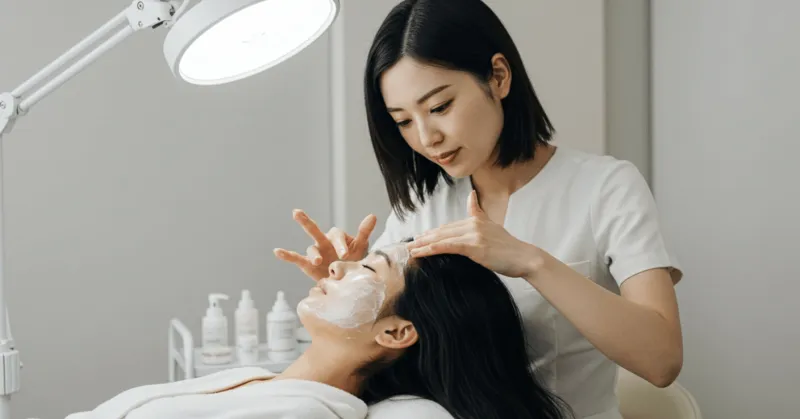
Photo: Japanese esthetician skin analysis consultation professional salon, via assets.st-note.com
Walk into almost any American beauty counter or med spa, and you will likely encounter a familiar ritual: a brief consultation, a quick glance at your pores, and a curated selection of products handed over with confident authority. The recommendations may be well-meaning, but they are rarely tailored to the precise, ever-shifting landscape of your individual skin. In Japan, this approach would be considered incomplete — even careless.
At the heart of Japan's most refined aesthetic salons lies a practice that has no true equivalent in mainstream Western beauty culture: skin mapping. It is a meticulous, deeply personalized form of analysis that treats each client's complexion as a living document, one that must be read carefully before any treatment is prescribed. For American women discovering this method for the first time, the experience is often described as revelatory.
What Skin Mapping Actually Involves
Skin mapping is not a single technique but rather a comprehensive diagnostic process. In Japanese aesthetics, a trained professional examines the face in zones, studying not only texture and tone but also moisture distribution, sebum activity, circulation patterns, and even the subtle ways stress or diet may be expressing themselves across different regions of the face.
Advanced salons in Japan frequently employ high-magnification skin analysis devices that illuminate the deeper layers of the dermis, revealing concerns that are not yet visible to the naked eye — early pigmentation, compromised barrier function, or areas of dehydration that masquerade as oiliness. The resulting portrait of a client's skin is genuinely unique, shaped by genetics, lifestyle, climate exposure, and the cumulative effects of every product she has ever applied.
What distinguishes this process from a standard consultation is the level of attention given to change over time. Japanese beauty professionals do not simply map the skin once and move forward. They document findings at each visit, tracking how the complexion responds to treatments, seasons, and life events. The skin is understood to be dynamic — and the approach to caring for it must be equally responsive.
The Philosophy Behind the Practice
Japanese aesthetics is deeply rooted in the concept of kirei — a word that encompasses not just physical beauty but a sense of clarity, refinement, and harmony. To achieve kirei, the skin must be understood on its own terms. Generic protocols, no matter how luxurious, cannot deliver this quality of result because they are designed for an imaginary average client rather than the real woman seated in the chair.
This philosophy extends beyond technique into the relationship between professional and client. In Japan, the aesthetician is regarded as a skilled practitioner whose knowledge is earned through years of training and close observation. The consultation is treated with the same gravity as a visit to a trusted physician. Clients come prepared to share details about their sleep, hydration habits, and emotional wellbeing — because these factors are understood to be inseparable from the condition of the skin.
For many American women accustomed to transactional beauty appointments, this level of engagement can feel unfamiliar at first. Yet those who experience it consistently describe a shift in how they understand their own skin — moving from frustration and guesswork toward a sense of informed, confident care.
Why Generic Advice Falls Short
The American beauty market is extraordinarily sophisticated in many respects. Product innovation is rapid, ingredient education has never been more accessible, and consumers are more informed than at any previous point in history. And yet, a persistent gap remains between the abundance of available information and the ability to translate that information into genuinely effective personal routines.
Part of the difficulty lies in the one-size-fits-all structure of most beauty guidance. A trending ingredient may be clinically proven to deliver results — but proven on which skin types, under which conditions, in which concentrations? A five-step routine celebrated by influencers may work beautifully for some complexions while quietly exacerbating sensitivity or disrupting the barrier function of others.
Skin mapping addresses this gap directly. Rather than asking a woman to adapt herself to a pre-existing system, it builds the system around her. The treatment protocol that emerges from a thorough skin mapping session is not a collection of popular products — it is a considered response to a specific set of conditions, designed to evolve as those conditions change.
Building Loyalty Through Results
In Japan, the relationship between an aesthetician and a long-term client is one of the most valued in the beauty industry. Client retention rates at respected Japanese salons are remarkably high — not because of aggressive loyalty programs or promotional pricing, but because the results speak clearly over time.
When a woman sees her complexion genuinely improve — when the persistent dullness she has carried for years begins to lift, or when a pattern of breakouts finally resolves after targeted treatment — she does not need to be persuaded to return. The trust is established through evidence. This is the quiet power of personalized skin mapping: it creates a feedback loop in which professional expertise and client experience continuously inform one another, producing outcomes that no product purchased off a shelf could replicate alone.
American women who have sought out salons offering this approach often describe it as the moment their relationship with skincare fundamentally changed. The shift is not merely cosmetic. It is a reorientation toward understanding the skin as something to be genuinely known rather than simply managed.
Bringing This Standard to Your Own Routine
While a professional skin mapping session offers the most thorough analysis, the underlying philosophy can begin to inform how any woman approaches her skincare at home. The practice of observing the skin with genuine attention — noting how it responds to humidity, to stress, to changes in diet — is itself a form of mapping. Keeping a simple record of how the complexion shifts week to week can reveal patterns that make product and routine decisions far more intentional.
For those ready to seek out professional guidance rooted in this tradition, it is worth looking for practitioners who prioritize consultation depth over treatment speed. The quality of the analysis is the foundation upon which everything else is built.
Japanese beauty has always understood that the most effective skincare begins not with a product but with a question: Who is this skin, and what does it truly need? Skin mapping is, at its core, the disciplined pursuit of that answer — and for the women who have experienced it, the results make the inquiry entirely worthwhile.