One Ritual, Refined Forever: The Japanese Case Against Reinventing Your Skincare Every Season
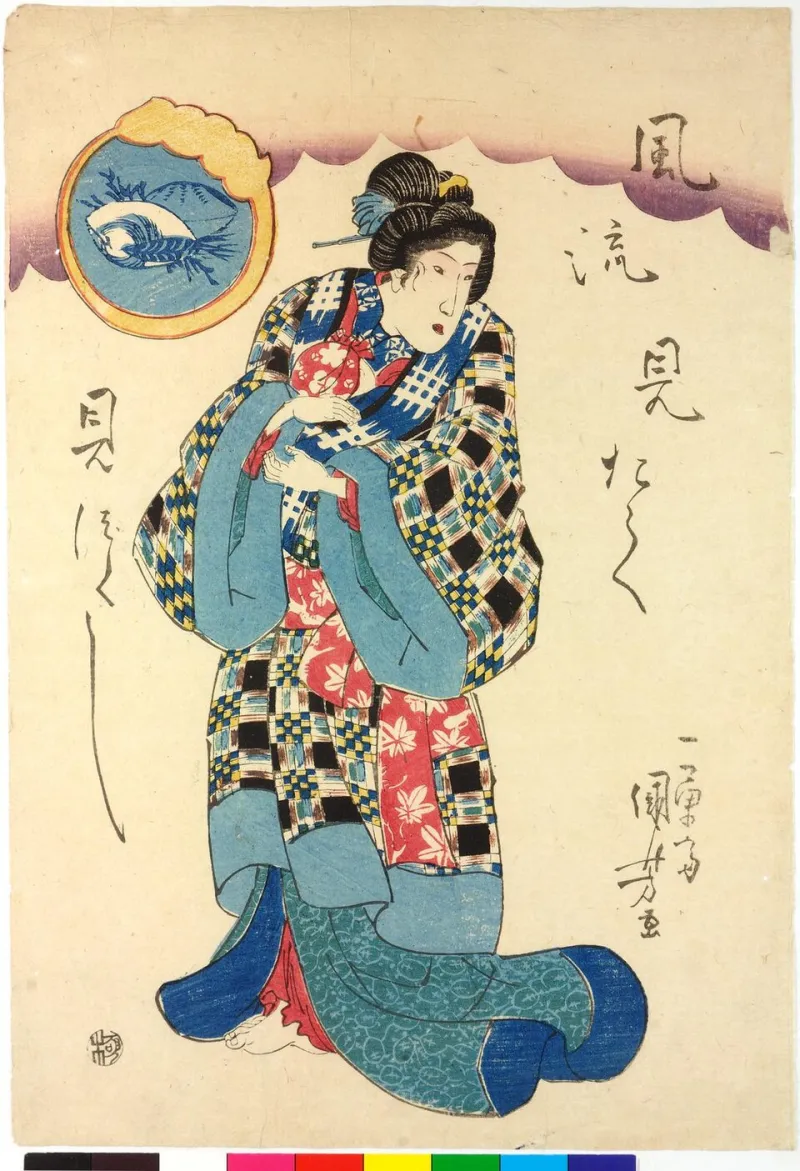
Photo: Print artist:Utagawa Kuniyoshi (歌川国芳), Public domain, via Wikimedia Commons
The Reinvention Trap Is Costing You More Than Money
Every September, the beauty industry delivers a new directive. Fall is here, and with it comes an implicit message: your current routine is no longer sufficient. New serums promise deeper hydration for cooler air. Richer moisturizers appear on shelves with autumn-tinted packaging. Influencers announce their "transitional skincare" hauls with the gravity of seasonal necessity.
American consumers, trained by decades of fashion's seasonal logic, have imported this rhythm wholesale into skincare. The result is a cycle of perpetual spending, perpetual experimentation, and—perhaps most frustratingly—perpetual uncertainty about what is actually working. If your routine changes every three months, you will never accumulate enough data to know what your skin truly responds to.
Japanese women, by contrast, operate from an entirely different premise. And the skin they carry into their forties and fifties speaks for itself.
What Gatinuma Actually Means
The word gatinuma does not translate cleanly into English, which is precisely why it carries so much meaning. At its core, it describes an intentional curation—the act of selecting only what genuinely belongs and releasing everything that merely occupies space. Applied to skincare, it is not minimalism for its own sake. It is the deliberate construction of a coherent system, followed by the discipline to protect it from unnecessary interference.
In Japanese beauty culture, a well-built routine is considered something close to an achievement. It represents self-knowledge: the understanding of one's own skin type, seasonal sensitivities, and the precise formulations that produce visible results over time. To abandon that system every few months in pursuit of a trending ingredient is not seen as curiosity or self-care—it is seen as a kind of waste. A waste of product, certainly. But more significantly, a waste of the accumulated understanding that only sustained practice can provide.
Why Product-Hopping Produces Mediocre Skin
There is a physiological argument against the seasonal overhaul that beauty marketing rarely wants you to consider: skin adaptation takes time. Most active ingredients—retinoids, niacinamide, vitamin C derivatives, exfoliating acids—require consistent, repeated exposure before their effects become measurable. Dermatologists frequently cite a twelve-week minimum for evaluating whether a new product is genuinely performing. Many consumers abandon their routines at week four.
The consequence is a skin barrier that is perpetually adjusting, never settling. Introducing new formulations before the previous ones have had time to integrate creates a baseline of low-grade irritation that many women mistake for sensitivity or dryness. The solution they reach for is, predictably, another new product.
Japanese skincare philosophy interrupts this cycle at the source. Rather than treating each new product as a potential upgrade, the gatinuma approach frames every addition as a potential disruption. The burden of proof rests on the new, not the established. Something earns its place in a routine through demonstrated, observable results over months—not through compelling packaging or a persuasive editorial feature.
The Economics of Staying Put
Beyond skin outcomes, the financial argument for routine stability is difficult to ignore. The average American woman spends significantly more on beauty products than her Japanese counterpart—not because Japanese skincare is inexpensive (it is often quite the opposite), but because the Japanese consumer makes fewer, more deliberate purchases. A bottle of high-quality essence that lasts four months and genuinely performs represents a different kind of value than four moderately priced serums purchased in sequence and abandoned before they are half-finished.
The gatinuma principle reframes the entire concept of skincare investment. Spending more on one product that you understand, trust, and will use completely is not an indulgence—it is efficiency. The American habit of treating skincare as a category where variety signals sophistication inverts this logic entirely. In Japanese beauty culture, a woman who has used the same moisturizer for seven years and whose skin reflects that loyalty is not considered behind the times. She is considered someone who knows exactly what she is doing.
How to Build a Routine Worth Keeping
The practical challenge, for many American women, is not accepting the philosophy of stability—it is identifying what is actually worth stabilizing around. This is where the gatinuma approach demands genuine patience and self-observation.
Begin by stripping back to the essentials: a gentle cleanser suited to your skin type, a hydrating toner or essence, a targeted treatment for your primary concern, and a moisturizer that seals everything in. Add sun protection as a non-negotiable daily step. This is not a capsule wardrobe for the face—it is a foundation, and it should be treated with corresponding seriousness.
From this foundation, introduce one variable at a time and observe for a minimum of eight weeks before drawing conclusions. Keep notes if it helps. Notice texture, tone, reactivity, and how your skin behaves across different environments. This is the kind of attentive, longitudinal observation that Japanese skincare culture treats as ordinary practice, but that American beauty media rarely encourages because it does not generate content.
When a new product appears in your orbit—through an advertisement, a recommendation, or a moment of browsing—apply the gatinuma filter. Ask not whether it sounds promising, but whether it addresses a specific, identified need that your current routine does not already meet. If the answer is no, the appropriate response is to appreciate the product from a respectful distance and move on.
Refinement, Not Revolution
There is a meaningful distinction between refining a routine and overhauling one. Japanese skincare culture does not demand rigidity. Skin does change—with age, with climate, with hormonal shifts. A moisturizer that served beautifully through your thirties may need to be replaced with something richer in your mid-forties. A summer routine may require a lighter-textured hydrator than the one you rely on in winter. These adjustments are appropriate, even necessary.
What gatinuma resists is the wholesale reinvention that treats your entire routine as obsolete the moment a new trend surfaces. Seasonal pivots, complete product overhauls, and the compulsive adoption of whatever ingredient is dominating beauty media this quarter—these behaviors are not refinement. They are noise.
True skin transformation is quieter than the beauty industry would prefer you to believe. It accumulates in the consistency of a cleanser used every evening, in the patient application of an essence that has been part of your ritual long enough to show what it is genuinely capable of. It looks, from the outside, almost unremarkable—until it doesn't.
That is the gatinuma glow. Not the result of finding the right product at the right moment, but of building the right system and trusting it enough to let it work.