Ten Minutes, Total Presence: The Morning Sequence Japanese Women Swear By

There is a particular kind of anxiety that sets in around 7:15 AM in American bathrooms. Serums waiting. Essences waiting. A ten-step routine borrowed from a video you watched at midnight, half of which you're not sure you're applying correctly. The result is not luminous skin—it's a rushed, distracted version of self-care that leaves you feeling behind before the day has even begun.
In Japan, the morning approach is quieter and, frankly, more disciplined. It is not about doing more. It is about doing a handful of things with complete attention. What follows is a ten-minute sequence built on that philosophy—designed for professionals who have a train to catch but refuse to abandon their skin.
Minutes 0–2: The Cool Water Reset
Japanese mornings rarely begin with a harsh foaming cleanser. Overnight, your skin has not accumulated much beyond its own natural oils, so a splash of cool or tepid water is often enough. The cool temperature does something a cleanser cannot: it gently wakes the skin, tightens the appearance of pores, and signals to your nervous system that the day has started.
If you wore an occlusive sleeping mask, a very mild cleanser is fine—but keep it gentle. The goal is to preserve the moisture barrier you spent last night rebuilding, not to strip it before 8 AM.
Minutes 2–4: One Lotion, Pressed Not Rubbed
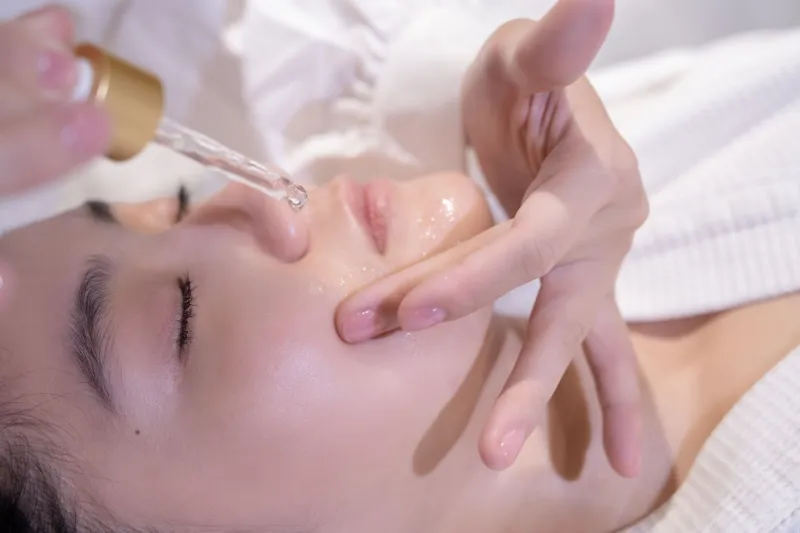
Here is where Japanese practice diverges most sharply from American habit. Rather than layering three hydrating products, choose a single hydrating lotion—the light, water-like first step known in Japan as keshousui—and press it into the skin with your palms.
Pressing, rather than rubbing, does two things. It minimizes tugging on delicate skin, and it forces you to slow down. You cannot rush a pressing motion. That pause is the point. This is the moment your routine stops being a checklist and becomes a ritual.
Minutes 4–6: Targeted Serum, Singular Purpose
If your skin asks for one thing—a brightening vitamin C derivative, a lightweight hyaluronic acid, a niacinamide for texture—this is where it goes. One serum. One concern. Japanese formulations tend to be elegant and multi-functional precisely so you don't need a shelf of them.
Resist the urge to stack. Layering five actives in the morning often leads to pilling, irritation, and a diminished barrier by afternoon. Your skin will tell you what it needs if you apply one thing and listen.
Minutes 6–8: Moisturizer as Architecture
A modest amount of moisturizer, warmed between the palms and pressed over the face and neck, seals everything beneath it. Think of this step less as hydration and more as construction—you are building a smooth, even surface that will hold up under makeup, office air conditioning, and the dry air of a pressurized cabin if you travel.
Don't forget the neck and the back of the hands. Japanese beauty culture treats these areas as part of the face long before American routines catch up.
Minutes 8–10: Sunscreen, the Non-Negotiable
If only one step survives a chaotic morning, it is this one. Japanese sunscreens—many of them with the weightless, watery finish that made brands like Biore and Skin Aqua famous in the US—are designed to be worn daily without a trace of white cast or grease.
Two finger-lengths of product, pressed evenly over the face, ears, and neck. Done. This single habit does more for long-term skin quality than any serum on the market.
The Mindset Shift: From Quantity to Presence
What makes this sequence work is not the products—it is the attention. A ten-minute routine performed with full presence delivers a skin benefit and a nervous-system benefit simultaneously. You begin the day grounded rather than frazzled, and that composure shows on your face before your first meeting.
American beauty culture often treats skincare as accumulation: more steps, more actives, more trends to catch. The Japanese morning tradition treats it as refinement. You are not falling behind by doing less. You are, in the truest sense, catching up to what your skin actually needs.